Christian is the worlds greatest expert on determinants, and this blog post is about my role in him being the greatest!
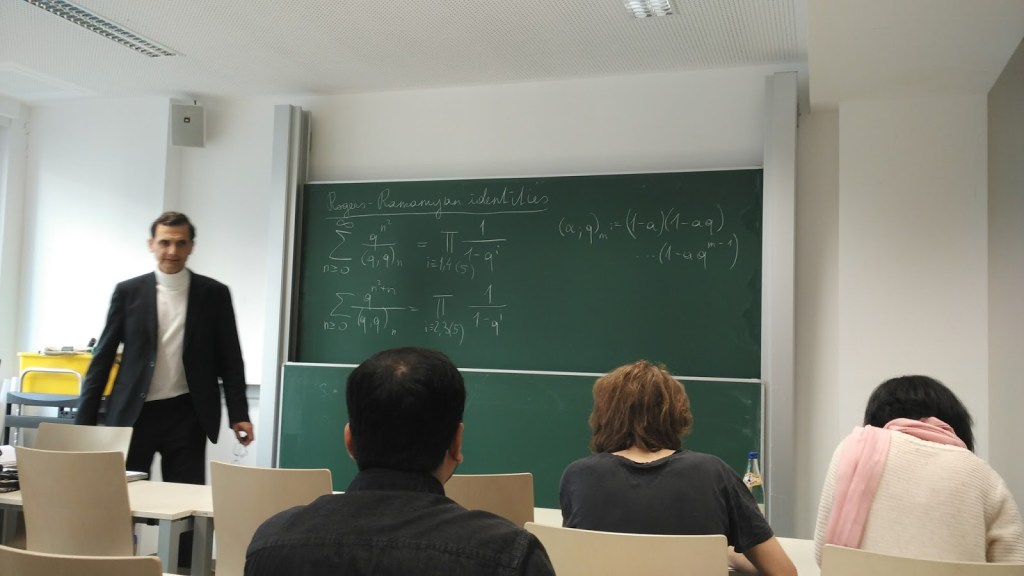
I attended Chirstian’s lectures of his course on Bijections given in the University of Vienna, during the period Oct 2016–Jan2017. The picture is of his lecture in Vienna, showing the Rogers–Ramanujan identities.
Christian is one of my earliest mathematical friends. His matrix inversion was among the set of results I was supposed to extend to multiple series over root systems. It was one of my PhD problems, which I couldn’t solve. (I did a special case, and the full extension was provided by his student — and my friend — Michael Schlosser.) This is one reason why we met and talked (a lot) during a workshop organised by the Fields institute in Toronto, in the summer of 1995. He was coming back to mathematics after a brief post-phd career as a pianist.
Let me explain why everyone knows that Christian is the world’s greatest expert on determinants. There are three reasons for it:
- His paper Advanced Determinant Calculus (ADC)
- His followup paper: Advanced Determinant Calculus: A supplement (ADC2)
- Richard Stanley said so.
After my PhD, I looked for a post-doctoral position. One very good possibility was in Vienna. Later I found out that Christian had applied for a grant for two postdoc positions that year. Unfortunately, only one of those was granted, and the position went to Michael! At any rate, many years later, I did become a post-doc in his group, and one of my serial post-doc positions was with him.
During my post-doc years, we spent a lot of time with each other, and looked at various types of problems together. Christian introduced me to the neighbouring Cafe Konditorie, which became my favorite coffee, breakfast and cake shop in the whole world. It was at this coffee shop where our first collaboration began.
I had just finished refereeing a paper by a Japanese mathematician. That paper evaluated a determinant in two ways to obtain a transformation formula for multiple basic hypergeometric series. Since he is the world’s greatest expert in determinants, it should have been easy for him to tell me which other determinants to apply the same trick and I can work out the details. At least, that is what I suggested to him.
However, he was in a different mood that day. He said that even though he is the world’s greatest expert in determinants in the world, there was a determinant he couldn’t do. Apparently Alex Miller had asked him a question in a recent visit to France, which he answered, but Alex raised an objection, which eventually led to a determinant which Christian couldn’t do. In fact, Christian knew the answer on the basis of small experiments in Mathematica (for n=1, 2, 3, 4), but couldn’t prove the formula in general, and was planning to leave it as a conjecture in his paper.
It is here that I played my role in his greatness. I said: how difficult could it be? If you know how to do it for n=1, 2, 3, 4, … then proving this formula by induction can’t be too difficult.
Indeed, it turned out that we could prove this determinant by induction. This led to our first collaboration:
Spiral determinants (with Christian Krattenthaler), Linear Algebra Appl., 52, 374-390 (2017) preprint.
This paper is recommended for students, because Christian has told the story of how the determinants in this paper were discovered as well as proved.
The only regret I have is that I missed the opportunity to collaborate with Alex Miller on this paper. He should have been a co-author, since it arose on answering his questions, and I don’t know why we didn’t ask him. (Alex and I met and became friends later, when he became a post-doc at Vienna.)
One benefit of this collaboration was that my Erdos number came down to 3 from 4.
This is not all. We have another paper on another determinant. This is reported here.




 Gaurav Bhatnagar
Leave a comment