Beauty in mathematics is seeing the truth without effort.
~George Polya
On the other hand, there is Halmos’ well-known dictum that “Mathematics is learnt by doing mathematics.” My teaching philosophy is to create a system by which students learn and interact with the material and their peers. As a result, my students often find themselves doing a lot of ‘doing’!
My approach is inspired by my experience of the Ross Program. (I took it as a graduate student.) Students who do make an attempt to stay with the system tend to learn a lot through the semester. They also make many friends. The theoretical underpinnings of this approach are explained in this paper I wrote many years ago, while working in the Center for Research in Cognitive Systems, NIIT’s R&D center.
If you work hard enough, then there is a real possibility that you will experience the truth of Polya’s dictum.
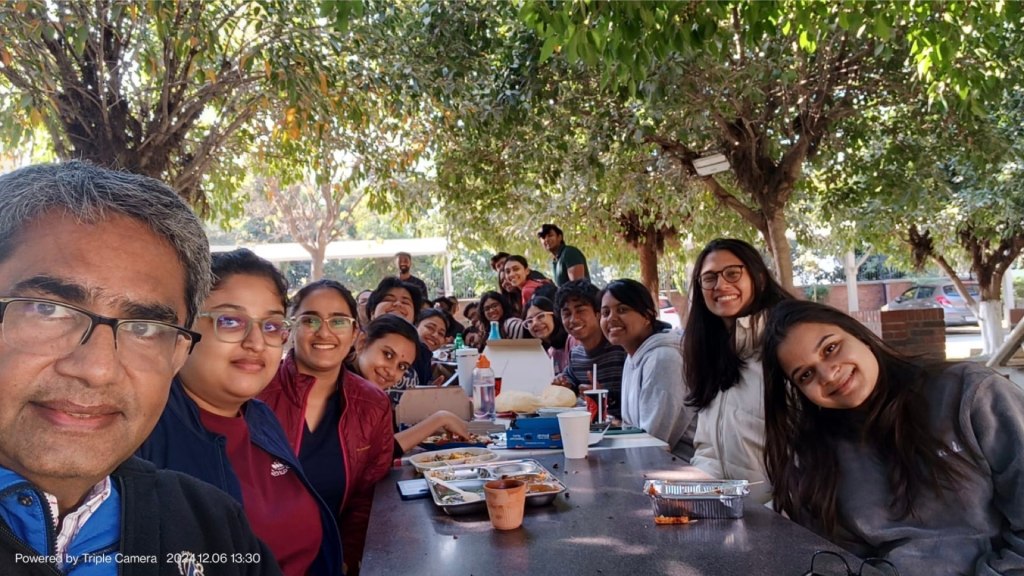

Pics from the class treat at the end of Monsoon 2024, Ashoka University
Teaching at Ashoka University (2020-2025)
Here is a list of courses I have taken at Ashoka. Click on the triangle to view the course description. Here are some of the lecture notes.
Calculus (Last updated: Jan 2025)
Linear Algebra (Last updated: April 2024)
Discrete Math (Problem Sets (Dec 2025))
Here are more pictures and some feedback from students at Ashoka: What they say about my teaching.
MAT 1000: Calculus
Offerred: Monsoon 2020, Monsoon 2021, Mondoon 2022, Monsoon 2023, Monsoon 2024
Course overview
The Calculus is a major achievement of humanity without which none of the developments in modern science or technology would have been possible. The course is a second look at the subject. I will say it a second time — it is a second look! So it is expected that you have done Calculus in high school.
It is an introduction to mathematics. The course is about building the intuition, knowledge and skills required for studying mathematics and other mathematical subjects. It is an `enabling’ course — a pre-requisite for every other mathematics course. It will probably help you develop the mindset for any other science too.
They say that Mathematics is learnt by doing mathematics. Be prepared for a lot of doing. In addition to lectures and discussion sessions, expect to spend 10-12 hours outside of class every week working on the material and working on problems; and more, if you have not done well in math in class 12.
MAT 1001: Linear Algebra
Offered: Spring 2022, Spring 2023, Spring 2024
Course overview
Linear algebra is one of the most important parts of mathematics, perhaps as important or more than the Calculus. Peter Lax (NYU) has remarked: “If you can reduce a mathematical problem to linear algebra, you can most likely solve it”. The introductory concepts (that we will study in this course) are easy to understand, but are powerful and apply in many contexts.
The applications to various fields are too numerous to mention. Lets just say that the modern world would not be so modern without the application of linear algebra, nor would our understanding of the universe would be where it is now. And neither would mathematics be as developed if all kinds of mathematical objects are not studied using linear algebra.
However, the course is mostly mathematical. Applications will be to understand some mathematical objects.The subject unfolds slowly over the semester. As you work through the semester, you learn how to extend your intuition of two and three dimensions to work in an n-dimensional space. At the same time, as the title of the main textbook reflects, this course may be regarded as an introduction to abstract mathematics. So you learn how to apply logical arguments to prove statements.
Its a busy course requiring a lot of effort and enthusiasm. You have to be young and energetic and want to learn a lot very quickly. But why am I saying this? You are Ashoka students. Of course you are young and energetic and want to learn a lot very quickly!
MAT 1004: Multivariable Calculus
Offered in Spring 2021
Course overview
The word dimension means the number of pieces of information required to identify a point in the space under consideration. For example, your eyes have three types of cones, sensitive to red, green and blue lights, and these three combine in various intensities to make the colors that we see. Thus the world of colors is three-dimensional. In the first course on Calculus, we consider one or two dimensional objects, with functions of one variable that can be visualized as graphs in the plane.
We continue the study of Calculus by considering functions that are defined parametrically and then functions of 2 or more variables and vector valued functions. The themes remain the same (quadrature, optimisation, linearization), but visualising what is going on is more complicated.
We will make use of the computer algebra system Sage to assist us in gaining intuition and for mechanical computations. This will get you started on a handy tool to use in understanding the new mathematics that you learn in the future.
The course is expected to be extremely useful if you study Physics, Chemistry, Computer Science, and of course, Mathematics.
CS1110/MAT 2203: Discrete Math
Offered in Monsoon 2025
Discrete mathematics, also known as Combinatorics, is a central field of study in mathematics. It is also very useful in the study of Computer Science, and lays the foundation for computational thinking required for the study of Algorithms and Data Structures, Compilers, Principles of
Programming Languages and Theory of Computation, and even Security. The word discrete is used as opposed to continuous. A better word is concrete (as opposed to abstract) because it combines continuous with discrete.
The theme is calculation and computation. We learn to compute various items, by hand, and by using a computer. There is a large variety of combinatorial objects to study, including graphs, permutations, trees, sets, paths, partitions of sets, partitions of numbers, and more. And then there are techniques: inductive thinking, recurrence relations, generating functions, probability calculations, big Oh calculations, summing series and solving equations of various kinds. These are called Manipulatorics, sometimes with affection, and at other times, derision.
The content is taken from the mathematical preliminaries section of Knuth’s The art of computer programming, who collated the classical material and made it accessible. The focus in this course is on techniques to solve problems. These are techniques of Euler, Gauss, Jacobi, Ramanujan — all gifted human computers. One expected outcome of the course is that you will become a better problem solver.
In fact, if you work hard, you will feel yourself becoming clever!
MAT 3030, 3031, 3121: Combinatorial Techniques
Offered: Monsoon 2020, 2021, 2022
Course overview
This course is an optional course for the Math program. It was slightly different each time it was taught, and it was offerred with different names each time. The following is the course overview of the previous version (2022).
Combinatorics is a central field of study in mathematics, with applications to Computer Science, Physics and Chemistry and of course to other parts of mathematics. We will examine many combinatorial objects and the techniques used to study them. The central question one can ask about the objects studied here is whether one can find how many they are (enumeration); and if two sets of objects have the same number of elements, then can one find a way to prove this by pairing an object from one set to the other (i.e., give an explicit bijection). We can also seek partial solutions, or solutions in terms of generating functions. There is a large variety of objects, including graphs, permutations, trees, sets, paths, partitions of sets, partitions of numbers, and many more. We will study a large sample.
The focus of the course is to learn combinatorial techniques for solving combinatorial problems. One expected benefit of the course is help you become a better problem solver.
MAT 3018: Complex Analysis
Monsoon 2023
Course overview
Complex analysis is one of the highlights of a mathematics education. They say that “the shortest path between two truths in the real domain passes through the complex domain”. Theorems and proofs in complex analysis, when you first encounter them, appear to be indistinguishable from magic!
However, all this only happens when one becomes adept at combining three different skills — analytical skills, algebraic manipulations (of series and products), and geometrical thinking. The goal of the course is to learn some of the basic moves so that you can begin to learn how to make magic yourself.
This course is mandatory for Mathematics students. It may be useful for Physics students too as background material and for Computer Science students interested in the analysis of algorithms. That said, we may only be able to cover the theoretical background, and may only hint at some applications.
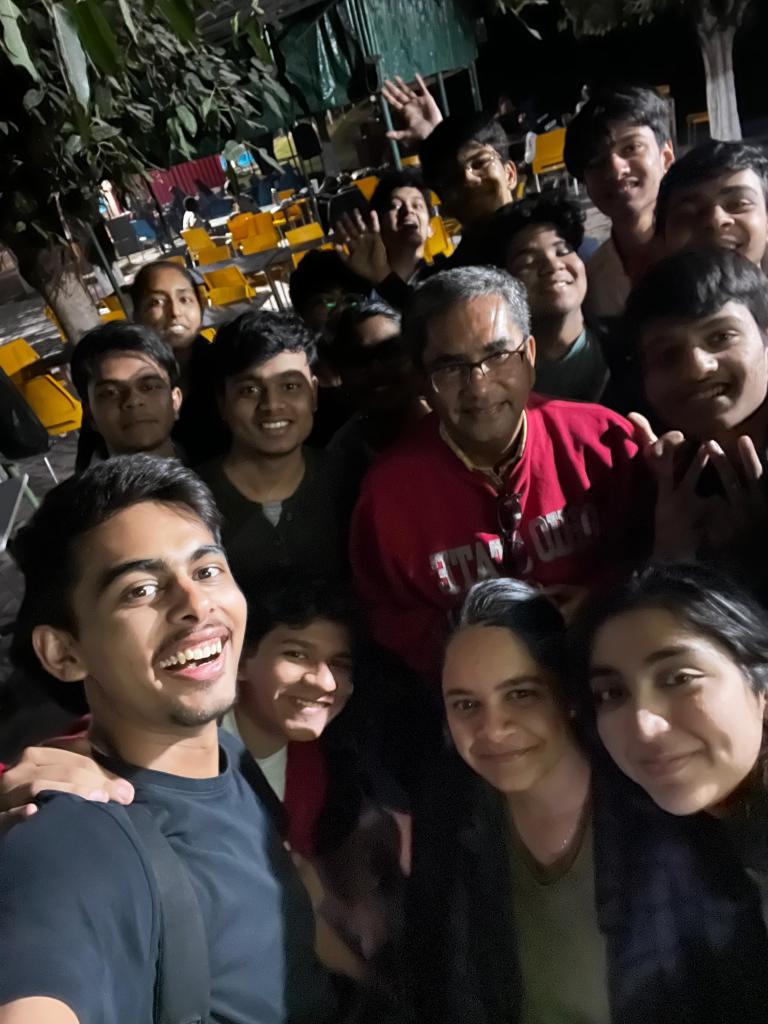
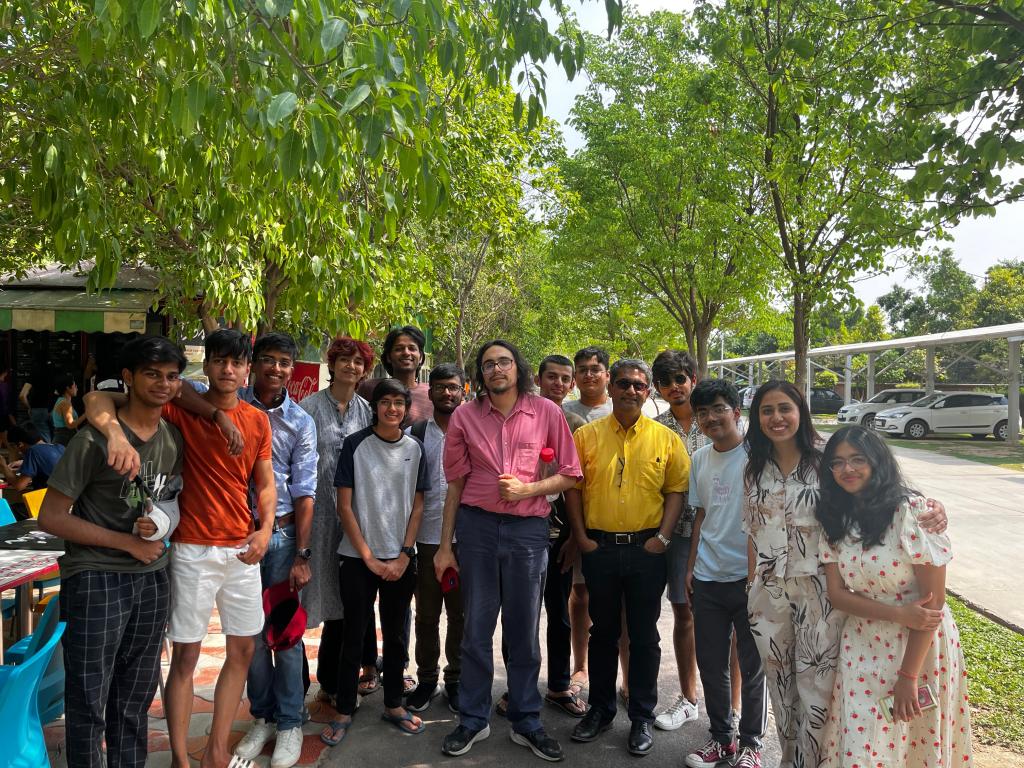
Class treat: Calculus 2023 and Linear Algebra 2024
In addition to the above, I have also taken a foundation course, FC 0306, Quantitative Reasoning and Mathematical Thinking. The contents of this course vary considerably. Here is a link to students’ work in QRMT Spring 2021 which may give you an idea of what goes on in this course. However, every year is quite a different experience. For example, the QRMT Spring 2023 did the puzzles (and suffered through all the jokes) in this book written for middle school children. In Spring 2024, the course is about Experimental Mathematics.
As part of the Summer 2024 math apprenticeship programme, Ojas Kumar (CMI), Sagar Shrivastava (TIFR and Ashoka) and I made a course: Twenty Problem Sets to learn Elementary Number Theory from Hardy and Wright. The problem sets and my (handwritten) solutions are available for download.
Summer Math apprenticeship programme
Since the summer of 2023, some Ashoka students were part of the Math Instruction Team in the Lodha Genius Programme. (Hot Tip: Summer TA positions are likely for students who do well in my Calculus class!) In addition, there is a Math Apprenticeship programme modelled on parts of Chicago’s Math REU. There are courses and students also write expository articles on a topic which they have not studied before. They are mentored by graduate students and faculty from around the world. In 2025, this programme will be fully funded by the Lodha Genius Programme and will be open to BSc/BS-MS second/third year students from around India.
- Summer 2023 Math Apprenticeship Programme articles.
- Summer 2024 Math Apprenticeship Programme details
Since 2025, I am no longer part of the LGP project.
Advice on various topics
Here are some links with some advice that may be relevant to you.
- Why do math? This question is answered in my interview in Annulus magazine
- What to study before you enter calculus. Here are some handouts made by Dick Askey and H. Wu.
- Computer Science students: Here is a book review I wrote on the topic of Computer Algorithms.
- Mathematics and Life, a speech I gave in the Millennium School.
About the featured graphic
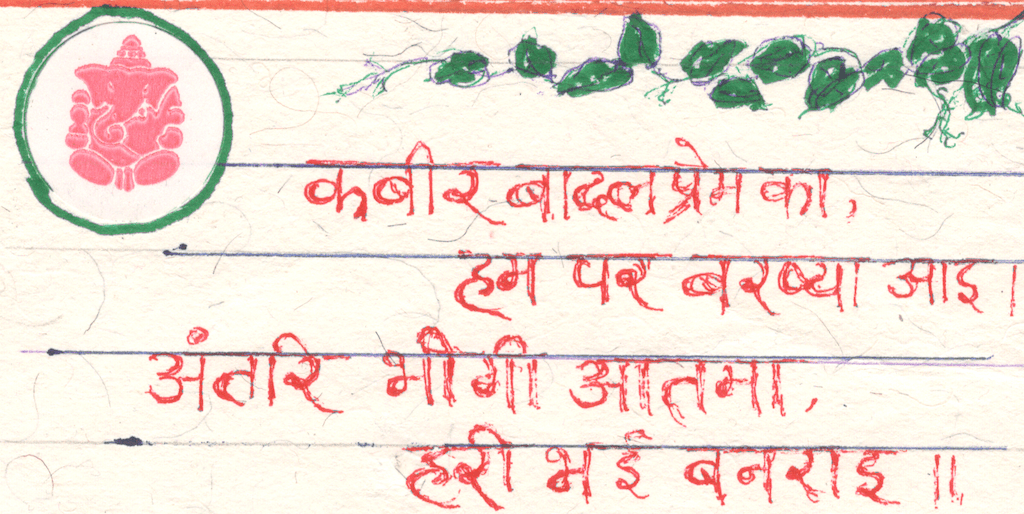
This is Kabir’s doha, in the handwriting of my mother (in another context). She used it to describe the love her students gave her and vice-versa. I use it in the same context. It perfectly matches my feelings for teaching in Ashoka (more than other places I have taught).
 Gaurav Bhatnagar