A good bet to lose?
This story is about my Linear Algebra course offered in Spring 2023. This is the second time I am teaching this; this time its fully offline.
The students are a mix. Some first years from my Calculus class from last semester, some who didn’t take Calculus with me but wish to go into math and many from Computer Science (second and third years too).
I meet Rohit (my student and the TA for Machine Learning last semester) and he tells me many of his students are in my class. That explains the unusually large crowd.
A couple of people from Economics are also there. One of them is a student who took Calculus with me. She is auditing the course. She should just take the course and get an A like she did the last time. But she expects to be busy, and just wishes to learn what she can in her final semester.
Neelam is the TF (Teaching Fellow) assigned for the course. We discuss the plan a bit and catch up. Last year Neelam and Anna were the TFs and they were both really good.
***
I meet Vivaan outside after a lecture. He was in my combinatorics class last semester. He is an Economics major, but is taking a large number of math courses in his last year. We’re chatting when a student from my class joins us.
“Professor, Akanxa took your class because she lost a bet,” says Vivaan. “Bet? What bet.” “We had a bet, and if she lost she had to take a math course of my choosing,” Vivaan explained.
I find out Akanxa is graduating this semester with a degree in Economics with a minor in Entrepreneurship.
What was the bet? Vivaan had to quit smoking for the month of December. If Vivaan had lost the bet, he would have had to take an entrepreneurship course with her this semester.
***
The course begins. Here’s the plan. Lectures (1.5 hours each) Mondays and Wednesdays; one hour discussion session with Neelam. A problem set on Thursday/Friday. Mondays there will be a quiz (during the lecture). We use Sage for computations.
The students’ routine is set. Study and try the problems on the weekend, to prepare for the Monday quiz. Lectures in the week are easier if you tried the problems. A new problem set for the next weekend. And repeat.
***
After 3 weeks, there is a midterm in the Monday lecture. This is a good time for people to have settled down in the semester and know if they are doing enough to do well. I tell students that if they are not doing as well as they wish to, they should consult Neelam or me on how they can do better.
Two of the first years who took Calculus with me come for a consultation. They are concerned they are not doing well, because they are competing with their seniors for the first time. They want reassurance; I tell them they are doing fine and keep doing what you’re doing.
As a matter of fact, they are topping the course. The seniors should be concerned about competing with the first year students!
***
Akanxa is doing fine, but as per the announced grade cutoffs maybe it is not clear. But her broad smile never changes. She’s enjoying the course for the sake of it.
Vivaan gives me some feedback. “Professor, your courses are really tough. I cannot believe you are doing permutations in Linear Algebra”. I think perhaps Akanxa is discussing problems with Vivaan to keep up in the course.
You are allowed, in fact encouraged, to discuss problems with others (“Math is a team sport”, “No one ever solves a big problem alone nowadays”, etc.). The problems in the Problem Set are becoming harder now.
***
Here is one of them; its of an exploratory nature. This problem is about a number theoretic matrix.
Let Gn be the n by n matrix with (i, j)th entry given by the GCD (greatest common divisor) of i and j.
(a.) Write down what are G1 , G2 , G3 .
(b.) Compute the determinants of G1 , G2 , G3 by hand.
(c.) Use Sage to calculate the determinant of Gn for several small values of n.
(d.) Go to OEIS.org to guess the value of the determinant.
(e.) Prove your guess.
Neelam announces that if you can solve it yourself, she will give ten extra credit points!
***
The mid-semester break is here. The students are now in two camps. Those trying the problems are following in class, and doing well in the quizzes. Others are waking up to the fact that one needs to study to do well.
After the mid-sem break Akanxa shows me her solution for the extra credit problem. I take it from her and try to understand it. It seems OK.
It looks different from any other proof I have seen. She has tested her statements in the proof on Sage. I ask her how long did it take? She says she’s tried it for several weeks.
Did it feel good to solve this problem? She says yes! She’s hooked on math problem solving now. She knows now how Vivaan feels about math.
***
The second midterm comes and goes. So far we have only covered the basics but by and large, more than half the students are with me. But the most important topics are yet to come.
The semester wears on. More quizzes. The semester is getting long. Students are feeling the pressure. Some of my bad stories are showing up on their twitter feeds. I had better slow things down and stop making remarks which I don’t wish to make public.
Before the last week, I hand in the final problem set. Overall, 99 problems were given in the problem set, many with multiple parts. Most of them are already covered in the quizzes and midterms. Anyone who has done most of them is bound to have become good in the course. (Here is a link to download the Problem Set).
Neelam and I decide to give an extra credit quiz which contains problems from earlier quizzes and midterms. This forces students to review the quizzes and midterms once. Its like prepping for a final.
The final, however, is a take home exam. I had told the students that more than 50% of the final exam will be problems from the Problem Sets. So if they have been keeping up, they should have an easier time with it. It is due at noon on the Wednesday of Finals Week.
***
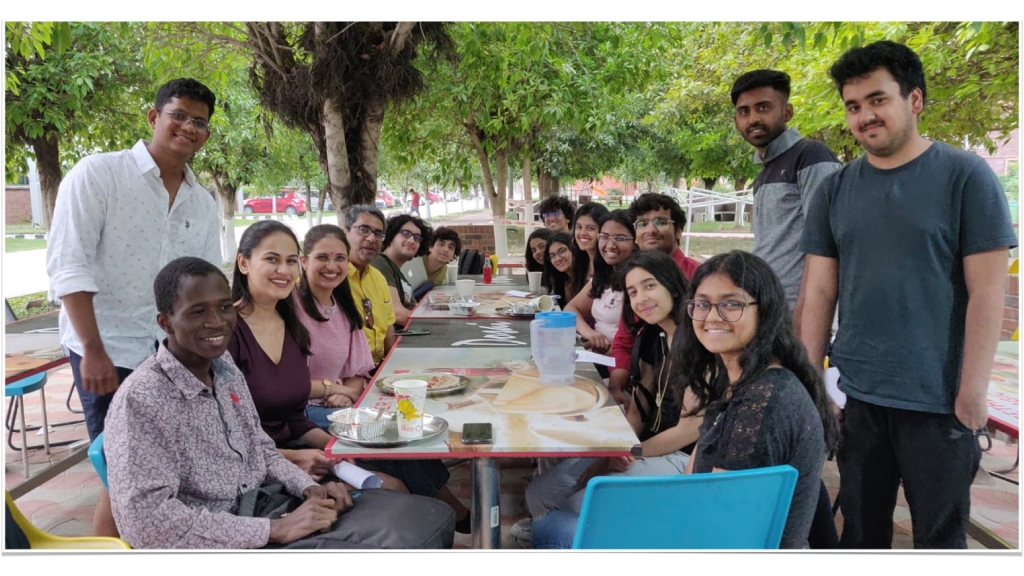
The students have worked hard through the semester. I offer to treat them to thank them for all the hard work through the semester. Many have exams and submissions that week, but still show up. The picture on the top of the page — it is a photograph of some of the students who found the time to come to Dosai for this treat. I’m in the yellow shirt, and Neelam is on my right.
Neelam hands back the extra credit quiz. The score indicates how much you have got from the previous quizzes and exams. As always, Bhumika has done well; for a change, she is happy with her performance. She is smiling. She takes Saptarishi’s paper to give back to him, and peeks at his score. He’s got 40/40 and Bhumika is no longer happy with her score. The perils of relative grading.
***
I am sitting with my colleague Ambika in my office since about 11 am on that Wednesday, when the final is due. A large number of students come in to drop off their final. To each student, I ask the same question: “Did you have a restful night?”
It doesn’t look like any one slept that night! But Ambika says she never saw so many happy faces.
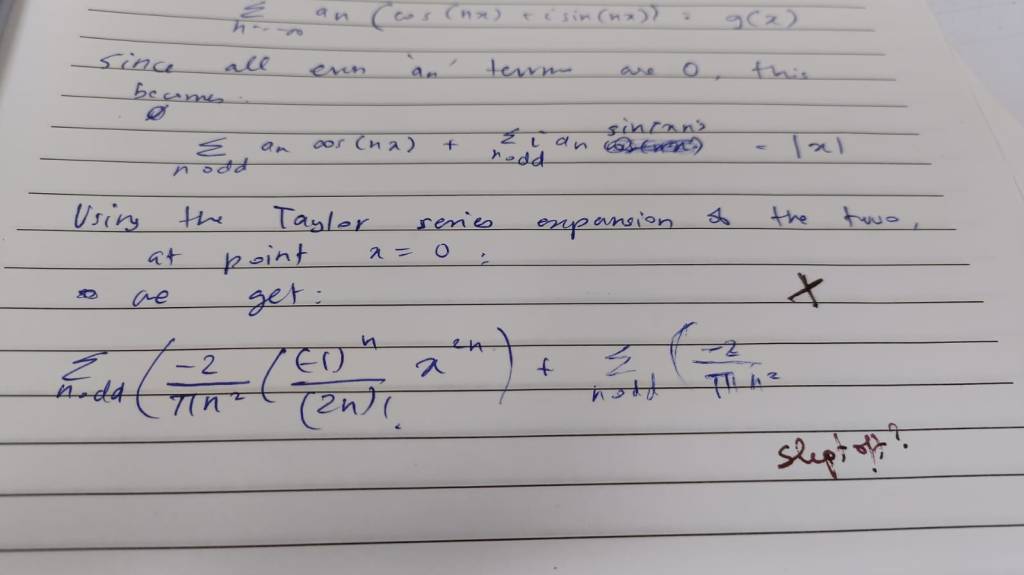
Sidharth comes running 2 hours late in a panic. “Will you accept the final? I slept off in the morning and only woke up now.” Of course I accepted it! Here is the sheet of his exam.
***
Akanxa also comes and drops off her final. She is wearing her usual broad smile. “I am feeling bad now that I will not be taking any more math classes,” she says.
“Was it a good bet to lose?”, I ask her.
I know her answer to this question. But what do you think? Was it a good bet to lose?

PS. A picture of Akanxa and Vivaan at their graduation. Vivaan dropped in my office the day after the final was due to ask me for a copy of the final exam. He said he wanted to try the final because he saw Akanxa enjoying it so much. I thought though it was to let me know that she did the problems on her own, without his help!
A gang of computer science students did very well too, along with the first year students. Almost everyone got something from the course. Akanxa got 196/200 in the final. Akanxa felt she is now addicted to Problem Solving. “I traded one addiction for another”, she commented.





 Gaurav Bhatnagar
Leave a reply to What They Say about my teaching – Gaurav Bhatnagar Cancel reply