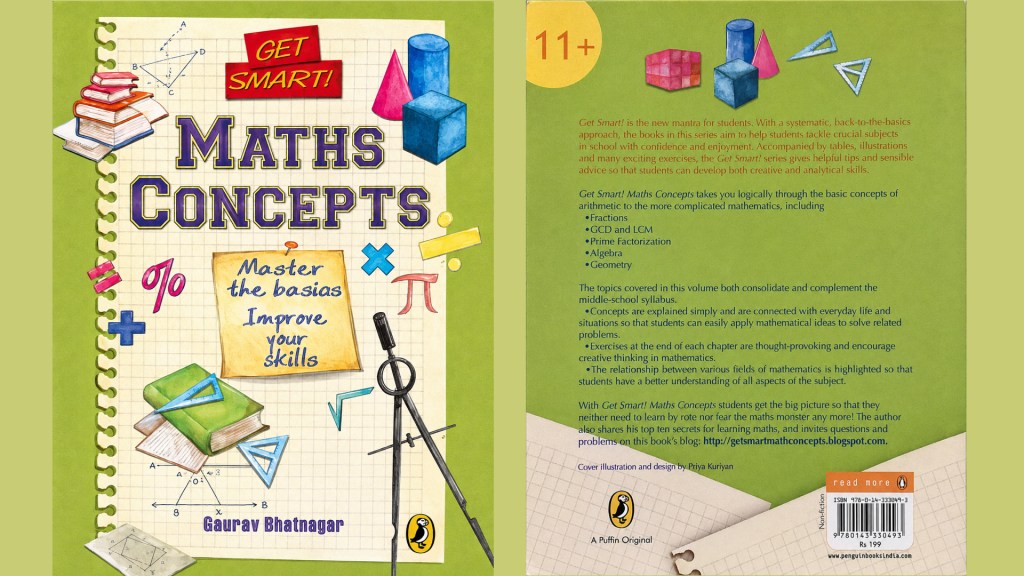
Written by Gaurav Bhatnagar. Published by Penguin (Imprint: Puffin), 2008.
The book is a survey of middle school math, and covers concepts that I feel will be useful for all students to know. It may even give a quick review of things you need to know in pre-algebra and algebra, before you encounter them again in a calculus class. The emphasis is on thinking mathematically, rather than just learning the procedures to solve problems.
This is available to buy from Amazon but it has gone out of print. I have taken back the copyright from Penguin and the plan is to make it available for free (for download) and available from Hem Aunty Publications (expected Jan 2027).
This book had a popular run. About 2000 copies were sold. It was written alongside my problem book Experience Mathematics and contains material that can serve as background material for this. It is meant to be read as a companion to your school textbook.
This book is dedicated to two of my school teachers. Here is what the inscription says:
Dedicated to
Mrs Asha Sarin and the late Mr I.S. Chawla, two amazing math teachers,
who got me hooked to math in the late 1970s and early 1980s in Modern School, Barakhamba Road, New Delhi.
Here is a book review by Tejasi written when she was quite young. Other than her, my nephew too liked it (he was in Mumbai) and many years later, a colleague’s (from Ashoka University) husband told me he read it as a kid and liked it.
Interestingly, the book has many conversations. They were the hardest thing to write. The Penguin editor, Vatsala Kaul (now at Hachette), helped me a lot with these. The idea was to show the “real world connect” of the mathematics, but not in an artificial way. We made it real by coming up with conversations between some children who were coming to learn math from me in my garage. Their names were of the children in my neighbourhood, who really did come to my classes over some summer!
Here is an excerpt from the first chapter:
“How did the test go?” I asked as Priya and Nitish came in.
“Good,” said Priya. “I got only one problem wrong. Nitish got one wrong too, but he says he did better than I did.”
“Priya’s test had only 25 questions. Mine had 50,” Nitish explained.
“No, Sir,” Priya protested. “His test was very easy!”
Priya and Nitish come to discuss mathematics with me a couple of times a week. Priya is 12 years old and Nitish is 13. They attend the same school and are neighbours. Our group also includes children of various other ages.
Who performed better—Priya or Nitish? Is getting one question wrong out of 50 better than getting one wrong out of 25? Should the difficulty of the questions matter? And how can we compare two results fairly?
This book explores mathematics through questions like the ones Priya and Nitish raise. When people first encountered situations requiring such comparisons, they were led to create the mathematical concepts that we use today.
<< some paras deleted>>
As for Priya (Grade 6), Nitish (Grade 7), and the others — Tejasi (Grade 6), Vasundhara and Aashna (Grade 8), will ask questions and discuss with each other the mathematics they study in school and other matters of interest to them. Their discussions will be related to various mathematical concepts and ideas discussed in this book.




Leave a Reply